
Watering Trees during Drought & Restriction
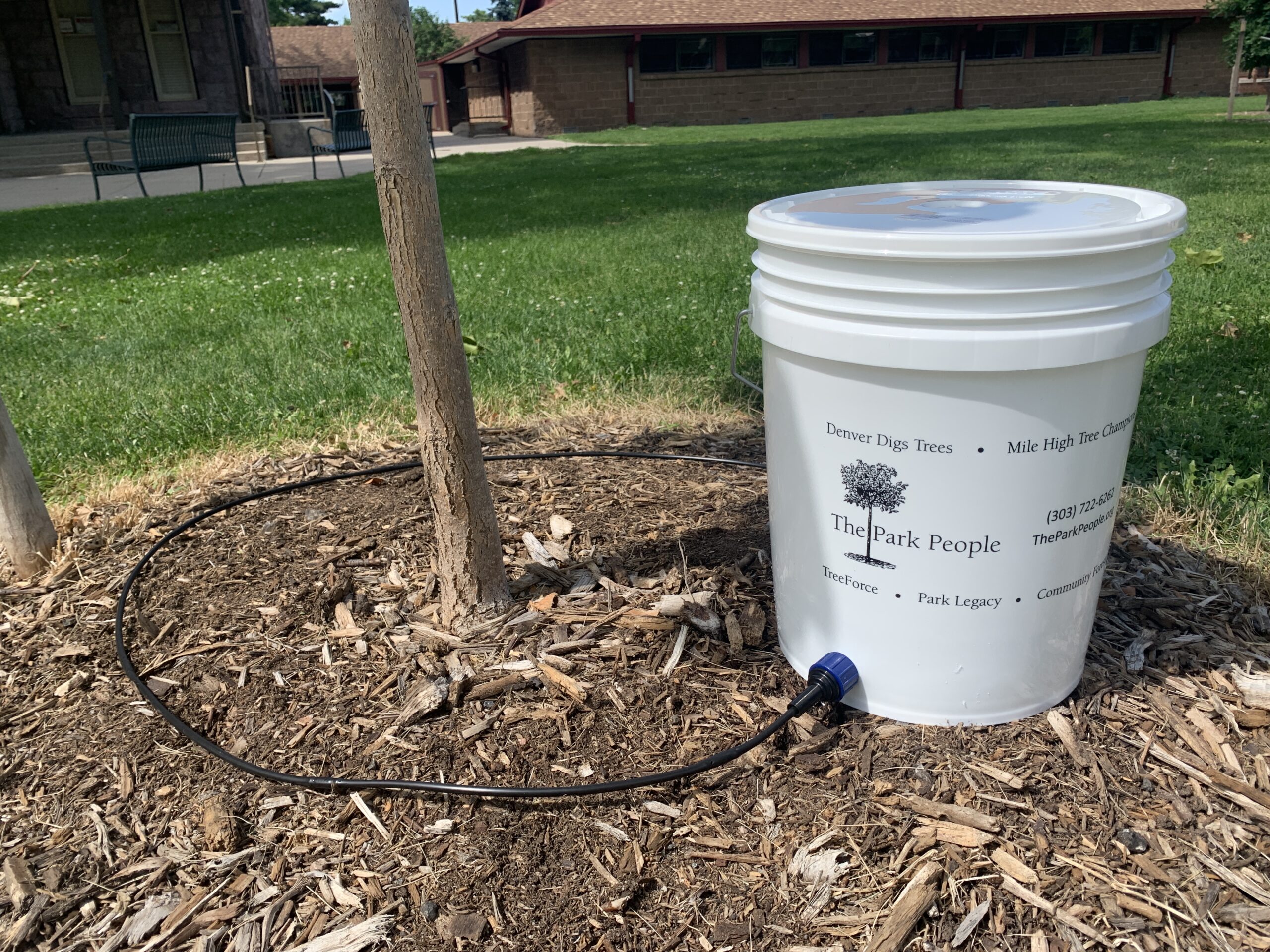
How To Water
We want to help you care for your tree, and can provide planting and care guides, as well as recommend specific tools and tactics for you to put into practice. However, every tree is different, and you have to get to know your tree and landscape, and determine what is best for you! These practices might also change over time as temperatures and extreme weather patterns increase. More heat and more wind means your trees and plants need more water.
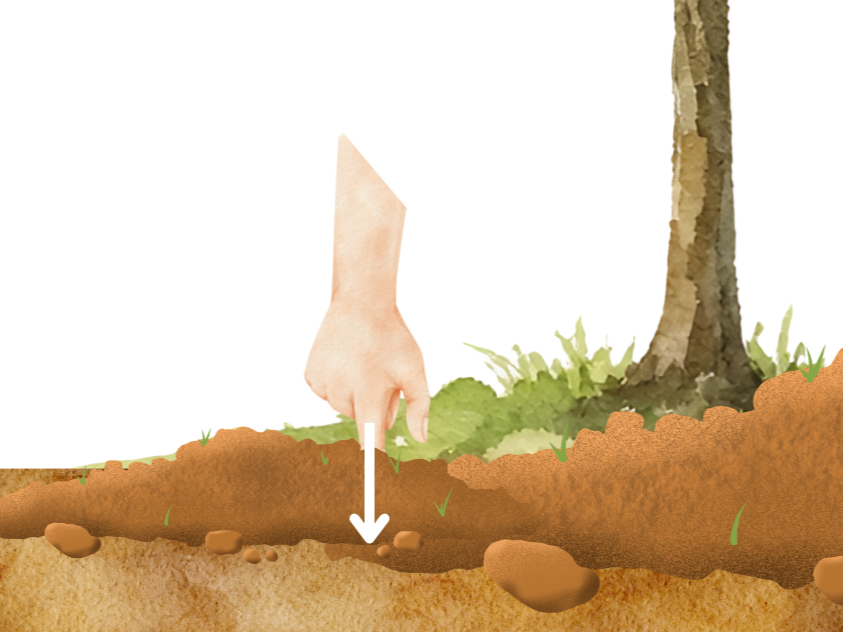
- Check Soil Moisture
Dig into the soil to see how wet it is. Placement is key: make sure you’re 4-6 inches deep into the soil
- For young trees (0-3 years), test 6 -12 inches from the trunk
- For more mature trees (3+ years), test multiple areas, including the drip line (the outermost point where a tree’s branches and leaves end)
If the soil is waterlogged, don’t water.
If it’s moist, you’re all good, check again later.
If it’s dry and crumbly, water!
*Special tip*: If you have a garden with groundcover plants (such as creeping thyme), you can use your plants as a moisture meter. They react to changes in moisture faster than trees. If your groundcover plants begin to dry out or rot, that is a signal that your moisture is off, and your larger plants and trees will soon be impacted.
If you want to buy a nifty tool, you can purchase a moisture meter online. Use the same above placements for putting the tool in the soil. Be warned however, that moisture meter tools react differently in different soil types, so place it deeper in a sandier soil than you would in a clay soil, and know that the reading may actually be less accurate than getting your hands dirty.
- Determine How Much Water Is Needed
Remember the 10:1 ratio –
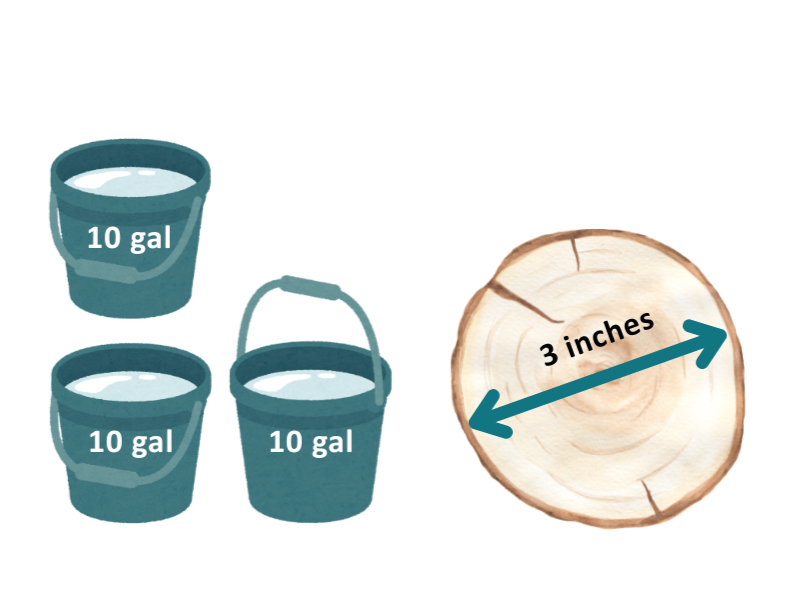
Your tree needs approximately 10 gallons of water for every 1 inch of its trunk’s diameter.
Example: if your tree is 3 inches in diameter, then it needs 30 gallons of water.
Tip: How to know when you’ve hit 10 gallons: Time how long your hose takes to fill a 5-gallon bucket, then double it.
- Water in the right place
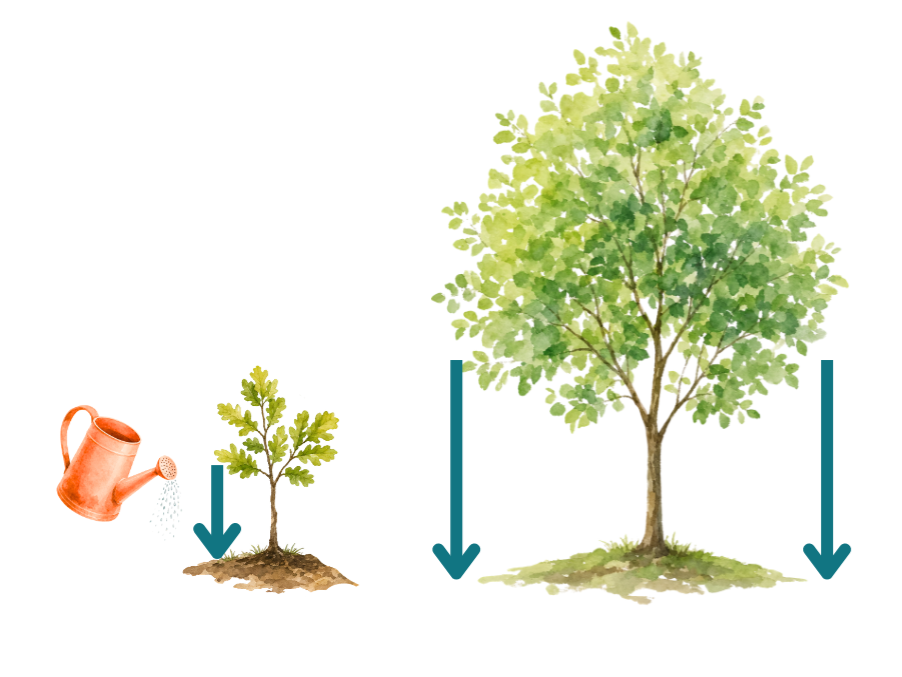
Water at the drip line. (this distance varies depending on the age of your tree)
Make sure you’re moving around the tree and not watering one single spot, equally distributing the water among all roots
Tip: Spread a layer of wood mulch 3-4 inches deep over the root area to conserve soil moisture. Keep it a few inches away from the trunk.
- Water in the right way
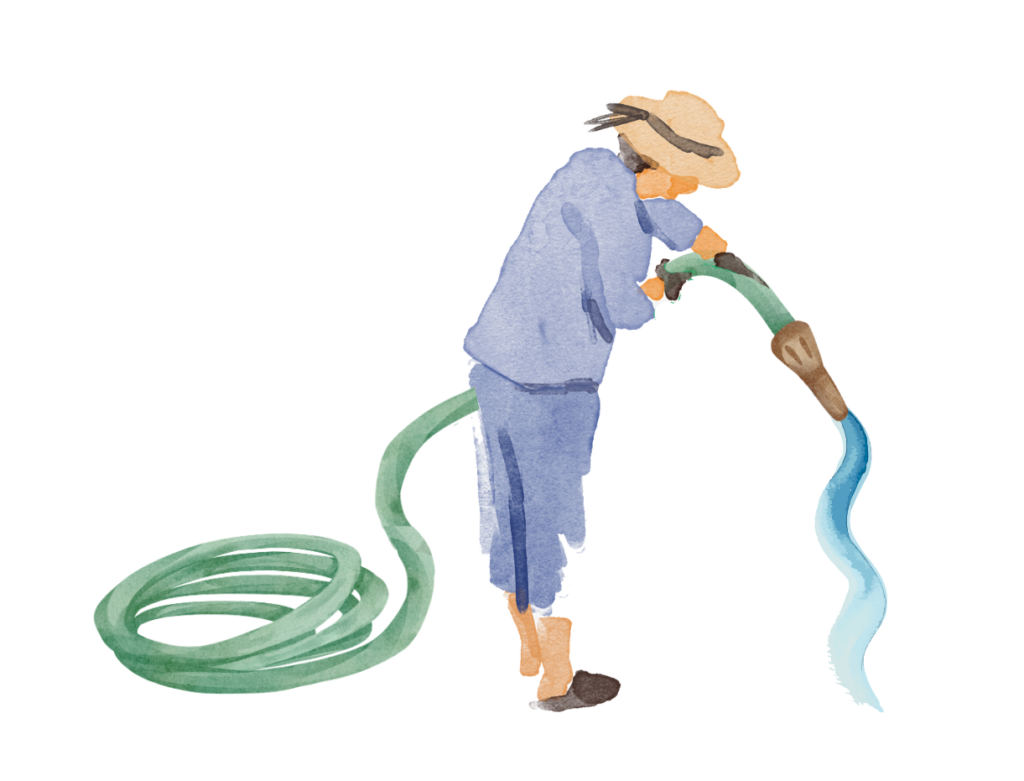
Most hand-watering involves holding a hose with a shutoff nozzle and manually circling and watering the tree at a steady pace, by hand.
You can also use a soaker hose, drip irrigation system, or a tree watering bag or ring.
The main takeaway with hand-watering is: have an eye on the water being used for the duration it is on.
- Water at the right pace
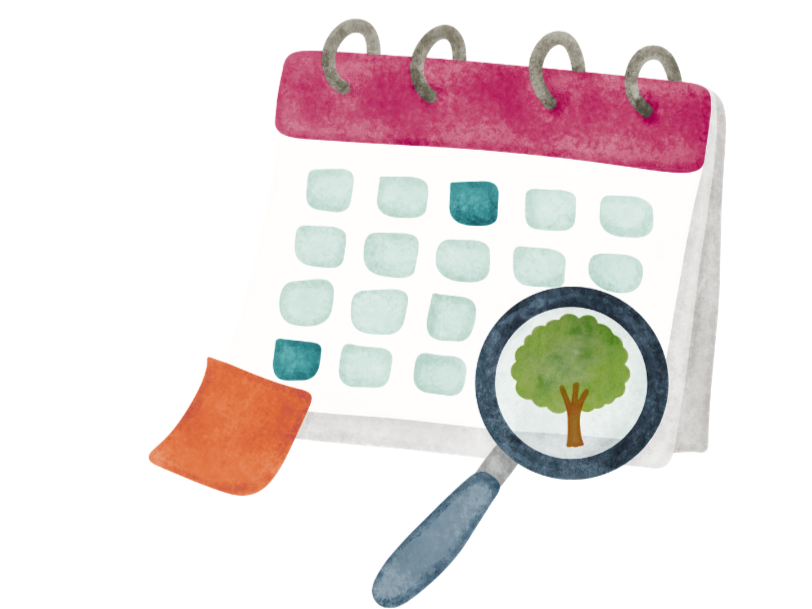
Water once a week as temperatures remain high and things remain dry. Water less frequently if temperatures get cooler and we get more moisture.
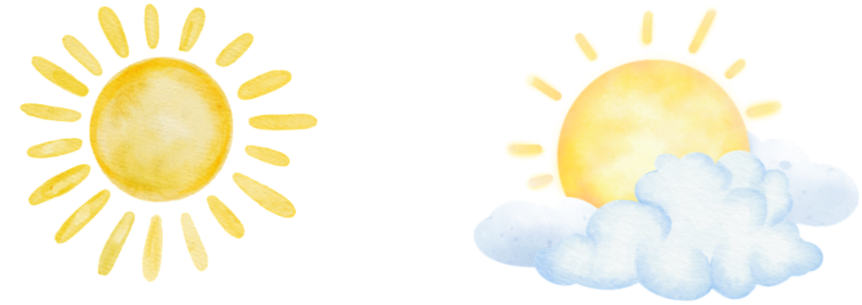
However, don’t stop watering entirely just because things get cooler or more moist. Rain is good but will not make up for the loss of last winter’s moisture. Keep checking your soil moisture and tree health regardless of temperature or rain!
6. Water at the right time
After October 1st, there are no day-of-week restrictions. If you are watering trees by hand, soaker hose, or drip irrigation, you can water any day.
After October 1st, there are no time-of-day restrictions. On hot days, avoid watering at mid-day to conserve water. On cool days, you can water any time. During winter, it’s important to water when it’s 40°or warmer so water can soak into the soil.
Ways To Hand-Water
We recommend hand-watering with a soaker hose or a hose nozzle and manually circling and watering the tree at a steady pace, by hand. You can also utilize a drip irrigation system, a tree diaper or bladder or donut, or a soaker hose. The main take away with hand-watering is: have an eye on the water being used for the duration it is on.
For other watering methods and irrigation solutions, further explore our resources page.
What’s going on?
Denver is in a Stage 1 Drought. Our reservoirs are only 60-75% full because of historically low snowpack, meaning our city’s water supply is shrinking. Because of this, residents are being asked to reduce their water use by 20% and stop lawn watering entirely. While we know this drought won’t last forever, we also know that drought and other forms of extreme weather are a part of our future. Trees play a key role in the health of our city, and will help us weather these ongoing extreme events. We see this as an opportunity to maximize our impact on the urban forest, to promote tree care and adapt our yards and neighborhoods to water-wise landscapes that will continue to provide you shade, while also harvesting available rainwater, protecting pollinators, and keeping Denver green and beautiful. With the right knowledge and tools, residents can ensure that our local trees thrive.
Why do we need to keep caring for trees and converting our landscapes?
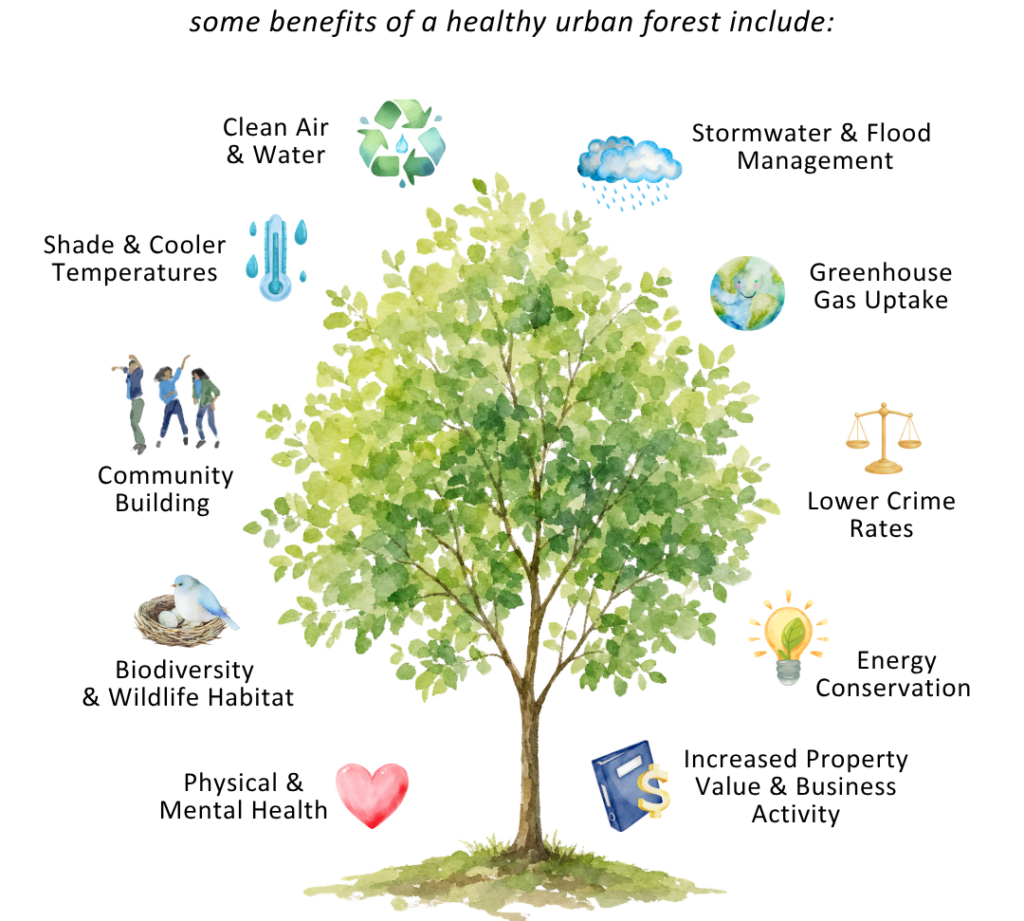
In times of drought, your first thought might be to pause planting and stop watering your trees. This is a natural reaction but please, don’t do that! Trees are infrastructure: they provide critical functions to our health and wellbeing. And we need them now more than ever. Continuing to plant and care for trees during drought and extreme weather actually buffers your community against a changing climate, and protects you and your home from heat, wind, fire, and more. Some tree benefits include:
- Trees are living air conditioners – they can lower temperatures by up to 15 degrees, release moisture into the air through their leaves, and keep the soil beneath them from drying out. This helps reduce the negative impact of future drought or extreme heat
- Our urban forest functions as an additional stormwater treatment facility. Trees reduce flooding and clean our water – and they charge next to nothing for it!
- Trees serve as wind breaks and filter air pollutants, helping you breathe better
- Deciduous trees help protect homes and minimize damage during wildfires
- Planting a diverse forest minimizes the negative impact of invasive plants and pests
- Trees and native and adapted gardens support pollinators and wildlife, and are sources of food
- Trees improve your mental and physical health, and can be a source of beauty and positive energy in your daily life
Even a year of suspended planting and/or care is a major setback to the health of our forest and our city. And they don’t require nearly as much water as you might think! With the right care and resources, you can keep your community healthy while spending little money and using little water.
Mythbusting! Let’s clear up some fear behind tree care and watering
“Watering a tree costs a lot of money!” FALSE. Watering trees is not as expensive as you think.
- It costs $3-10 a year to water a newly planted or young tree
- It costs $10-20 a year to water an older or more established tree
- Older trees need deeper, more thorough waterings than younger trees, but don’t need to be watered as frequently. You will average 26 waterings a year for a young tree, and 10-12 for an older tree.
“Watering my turf lawn is cheaper than watering trees.” FALSE. Turf lawns are more expensive and less beneficial to your health and community than trees and gardens. Let’s break down the cost of watering a tree versus watering a lawn under Denver Water’s Tier 2 pricing:
- How much water and money it takes to maintain a lawn:
- The average Denverite has a 1,600 square foot lawn
- That lawn uses more than 28,000 gallons of water a year
- If 1000 gallons of water costs $6.54, you’re spending about $183 a year just to water grass you might not even be using!
- How much water and money it takes to maintain a tree:
- The average tree uses 10 gallons of water for each 1 inch of the trunk’s caliper (diameter)
- This means a young tree with a 6 inch trunk takes 1,560 gallons of water a year
- With the amount of water you’re using on a lawn, you could water 18 of those 6 inch trees!
- Turfgrass has a place in our communities — on playing fields, in parks where kids run and play. But the lawn you only touch to mow? That’s the lawn worth rethinking.
“My lawn sprinklers water my tree for me.” FALSE. Trees need deep and focused watering to promote root growth. Sprinklers scatter water. You might be watering your sidewalk more than your tree.
“Trees are a luxury that I can’t afford or access.” FALSE. Trees are affordable and critical to your well-being!
- Trees are essential infrastructure that can and should benefit all residents
- The Park People offers trees for free or at little cost to all Denver residents through Denver Digs Trees
“We live in a prairie so we shouldn’t even be planting trees.” FALSE. We live in a city, a built environment, and must maintain it.
- We don’t plant trees because Denver used to be a forest. We plant them because Denver is now a city. We built the heat island. Trees are how we unbuild it.
- Human development and urbanization has increased the need for trees, since we have to offset the impact of paved surfaces, built infrastructure, and rising temperatures.
“Mature trees don’t need to be watered.” FALSE. Mature trees still need to be watered about 10-12 times a year.
- Think of your tree as a child. While they might need more attention as a toddler, they still want your love and support as they get older!
“Trees take up too much space.” FALSE. While a tree does need to be spaced properly when planted for its root zone and canopy to grow, a mature tree grows over your yard, leaving the majority of your landscape free and usable.
- The trunk itself uses up to 2 feet of space in your yard and soon enough, the branches will be over your head and even over your roof, providing protection without taking up much space.
- A tree’s shade can help your landscape stay cooler and retain moisture, keeping them comfortable and usable.
- Check out our spacing guidelines for planting trees Denver to keep free space in your yard while getting the most shade.
“Trees damage infrastructure and break water lines” FALSE. Trees will do their best to grow with the path of least resistance.
- Utility Conflicts. A growing root cannot create an opening in a pipe but it can exploit an existing opening in a pipe
- Right Tree Right Place. A tree that is planted with proper spacing guidelines is unlikely to damage your home or power lines. A tree that is planted without proper spacing guidelines may crack a sidewalk. This can be avoided by planting and caring for a tree properly, minimizing and even eliminating damage to infrastructure.
- Check out our spacing guidelines for planting trees Denver to minimize or eliminate damage to infrastructure.
Additional Resources for Tree Care During Drought
- Colorado Department of Agriculture: Drought
- University of Florida IFAS Extension: Tree care during a drought
- Texas A&M Forest Service: Watering trees during drought
- Colorado State Forest Service: How to water your trees this winter
- This resource also applies to other seasons of dry or cold periods
Categories